


Islam,Terrorism and Jihad
How A War Verse Is Used Wrongly:

Islam,Terrorism and Jihad
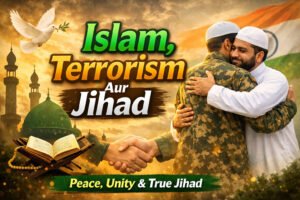 Qur’an 47:4, Radical Propaganda, Classical Islamic Response and Contemporary ContextualisationOver the last few decades, some Qur’anic verses originating from contexts of war have been removed from their historical, law, and ethical contexts to be transformed into appeals for violence that are timeless. One such verse widely abused is Qur’an 47:4 from Surah Muhammad. In India, a country with Muslims as its religious minority under a democratic government, the effects of this abuse have been particularly damaging. Extreme preachers, jihadist recruiters using the Internet, and global extremist networks cite this verse as a basis to argue that Islam justifies the unlimited killing of non-Muslims. This interpretation is not only morally distressing but also religiously mistaken. It runs completely against how Classical Islam has been understood over fourteen centuries and against how the Prophet Muhammad lived.
Major points:
The misinterpretation of this verse also hurts the Muslims themselves by fuelling suspicion, supporting repression, and isolating communities.
It also drains the Qur’an of moral depth and turns it into a tool of anger. Classical Islamic tradition sees scripture as a living ethical guide, embedded in context, law, and compassion. Qur’an 47:4 is not a call to terror. It is a rule of war aimed at containing bloodshed and bringing combat to an end.
To interpret it to the contrary is not righteousness but disinformation. In India today, upholding the literal meaning of such verses is an ethical obligation, a civic imperative, and a bulwark against ideology corrupting faith.
Over the last few decades, some Qur’anic verses originating from contexts of war have been removed from their historical, law, and ethical contexts to be transformed into appeals for violence that are timeless. One such verse widely abused is Qur’an 47:4 from Surah Muhammad. In India, a country with Muslims as its religious minority under a democratic government, the effects of this abuse have been particularly damaging. Extreme preachers, jihadist recruiters using the Internet, and global extremist networks cite this verse as a basis to argue that Islam justifies the unlimited killing of non-Muslims. This interpretation is not only morally distressing but also religiously mistaken. It runs completely against how Classical Islam has been understood over fourteen centuries and against how the Prophet Muhammad lived.
The verse says:
فَإِذَا لَقِيتُمُ ٱلَّذِينَ كَفَرُوا۟ فَضَرْبَ ٱلرِّقَابِ حَتَّىٰٓ إِذَآ أَثْخَنتُمُوهُمْ فَشُدُّوا۟ ٱلْوَثَاقَ فَإِمَّا مَنًّۢا بَعْدُ وَإِمَّا فِدَآءً حَتَّىٰ تَضَعَ ٱلْحَرْبُ أَوْزَارَهَا ۚ ذَٰلِكَ وَلَوْ يَشَآءَ ٱللَّهُ لَٱنتَصَرَ مِنْهُمْ وَلَـٰكِن لِّيَبْلُوَا۟ بَعْضَكُم بِبَعْضٍۢ ۗ وَٱلَّذِينَ قُتِلُوا۟ فِى سَبِيلِ ٱللَّهِ فَلَن يُضِلَّ أَعْمَـٰلَهُمْ
“So, when you meet those who disbelieve in battle, strike the necks; then when you have subdued them, bind them firmly; then either release them graciously or ransom them, until the war lays down its burdens. That is so, and if God had willed, He could have taken vengeance upon them Himself, but He tests some of you by means of others. And those who are killed in the way of God, He will never let their deeds be lost.”
Read in full and context, this is not an invitation to terror but a wartime rule limited to a specific historical moment. Yet extremist thinkers remove that context and turn it into a message of endless violence.
These radical groups, such as Al-Qaeda and ISIS, have quoted only the phrase "strike the necks” and removed what comes after. Through this phrase, it has been shown in ISIS propaganda as an act of divine endorsement for beheadings, suicide attacks, and mass killings of civilians. Many ISIS videos began with a recitation of Surah Muhammad. Such acts are represented as religious duties, not crimes against humanity.
This selective quoting is a tactic. In extremist ideology, the distinction between battlefield fighting and civilian life is to be eliminated. In so doing, they transform the entire world into a battlefield, making every Muslim a potential fighter. This approach denies fourteen centuries of Islamic legal thought.
This distortion is particularly perilous in India. Indian Muslims live in a nonmilitary, secular democracy with rights, political representation, and legal avenues to address grievances. Classical Islamic law carved out strict prescriptions for Muslims under non-Muslim rule; notions like aman (security) and ahd (covenant) posit that Muslims who live peacefully in such societies must abide by the law, eschew rebellion, and guard social harmony.
Yet some extremist preachers connected to global jihadist ideas denote India as a land of war, or Dar al-Harb, and proclaim violence religiously correct. This is not rooted in any classical law. Rather, it is a modern political ideal draped in religious terms to transform political indignation into a sacred battle. By using Qur’an 47:4 this way, they give divine language to what is really political anger.
To see why this reading is wrong, we have to begin with the why of the revelation. Traditional scholars maintain that Qur’an 47:4 was revealed during a war between the early Muslim community in Medina and the Quraysh in Mecca. Scholars such as Ibn Abbas elaborated that the verse addressed struggles on the battlefield, not everyday social or daily life encounters. The phrase "when you meet those who disbelieve” suggests military confrontation, not encounters with neighbours or traders.
One of the most misleading claims made by modern Islamist ideologues is that their violent reading of Qur’an 47:4 represents “classical Islam”. A careful reading of early tafsīr literature shows the opposite. Classical scholars were deeply cautious about war verses and constantly stressed their limits.
Classical scholars refute radicals
Al-Tabari, writing in the third Islamic century, explained that the phrase “strike the necks” must be understood as a battle idiom, not a literal instruction to execute captives or civilians. In Arabic rhetoric of the time, “neck” symbolised combat engagement, not cruelty. Al-Tabari explicitly connects the command to the moment of confrontation between two armed forces. Once that confrontation ends, the legal ruling changes immediately. For him, the heart of the verse lies not in killing but in restraint after victory.
Al-Qurtubi goes further by stressing that Qur’an 47:4 was revealed to limit excess, not encourage it. He notes that before Islam, victorious armies often slaughtered prisoners. The Qur’an replaced this practice with two humane options: release or ransom. Al-Qurtubi clearly states that killing prisoners after subjugation contradicts the verse’s purpose.
Fakhr al-Din al-Razi introduces an important ethical dimension. He argues that if the aim of war were killing itself, the verse would not mention the end of war at all. The phrase “until the war lays down its burdens” shows that violence is tolerated only as long as aggression exists. Once the cause ends, continuing violence becomes oppression, which the Qur’an condemns elsewhere.
Ibn Ashur, writing in the twentieth century but grounded in classical tradition, interpreted the verse as an early form of humanitarian law. He observed that Qur’an 47:4 introduces a regulated framework that anticipates modern laws of armed conflict, especially in its treatment of prisoners of war. Ibn Ashur explicitly rejected using this verse outside recognised warfare, calling such usage a distortion of divine intent.
Across these tafsīrs, a consistent pattern emerges. None of them read Qur’an 47:4 as a general command to kill non-Muslims. All of them treat it as exceptional, conditional, and temporary.
Tafsīr Through the Qur’an Itself: How Other Verses Limit 47:4
Classical scholars also insisted that no verse can be interpreted in isolation. Qur’an 47:4 must be read alongside other Qur’anic verses that regulate warfare
The Qur’an says:
وَقَاتِلُوا۟ فِى سَبِيلِ ٱللَّهِ ٱلَّذِينَ يُقَـٰتِلُونَكُمْ وَلَا تَعْتَدُوٓا۟
“Fight in the way of God those who fight you, but do not transgress.” (2:190)
This verse clearly limits fighting to those who are actively engaged in combat. Early jurists consistently cited this verse to prevent the expansion of war beyond necessity. Qur’an 47:4 does not override this rule; it operates within it.
Another verse states:
وَإِن جَنَحُوا۟ لِلسَّلْمِ فَٱجْنَحْ لَهَا
“If they incline towards peace, then incline towards it.” (8:61)
Classical scholars argued that if peace is offered, continuing violence becomes unlawful. Extremist groups ignore this verse because it contradicts their ideology of perpetual war.
Hadith Literature: Reinforcing Restraint and Moral Boundaries
The Hadith tradition provides further limits on Qur’an 47:4. The Prophet Muhammad’s instructions during military expeditions were consistent and repeated.
He commanded:
لَا تَقْتُلُوا الْخَرَاجِينَ وَلَا الْمُقْعِدِينَ
“Do not kill those who are not fighting.”
This Hadith was cited by jurists to exclude monks, farmers, traders, and civilians from any harm. The Prophet also said:
اغْزُوا وَلَا تَغُلُّوا وَلَا تَغْدِرُوا
“Fight, but do not steal, do not betray, and do not mutilate.”
Extremist practices such as beheading videos, public executions, and suicide bombings directly violate these instructions. From a Hadith perspective alone, their interpretation of Qur’an 47:4 collapses.
South Asian Juristic Tradition: A Forgotten Legacy
The Hanafi school, dominant in South Asia, developed an especially strong doctrine against vigilantism. Jurists writing under the Delhi Sultanate and Mughal Empire consistently ruled that Muslims living peacefully under a sovereign authority were forbidden from initiating violence.
Texts such as FatawaeAlamgiri, compiled under Aurangzeb, emphasised that rebellion and unsanctioned warfare cause greater harm than injustice itself. This tradition strongly influenced Indian Muslim ethics well into the colonial period.
Radical readings of Qur’an 47:4 are therefore not only un-Islamic but also un-Indian in Islamic terms.
Modern Tafsīr and the Crisis of Political Islam
In the twentieth century, Qur’an 47:4 began to be read through a new lens shaped by colonial trauma, authoritarian regimes, and revolutionary politics. Ideologues like Sayyid Qutb reframed war verses as part of a cosmic struggle between belief and disbelief. While Qutb did not personally advocate random violence, later militants radicalised his language.
Contemporary scholars have worked to undo this damage.
Abdullah bin Bayyah insists that applying war verses without authority, context, and moral purpose violates maqasid alshari‘ah, the higher objectives of Islamic law. He argues that protecting life takes precedence over ideological purity.
Similarly, scholars like Muhammad Tahirul Qadri have issued extensive fatwas declaring terrorism categorically haram, explicitly citing Qur’an 47:4 as a verse that extremists have falsified through decontextualization.
Qur’an 47:4 in Contemporary International Politics
In modern geopolitics, extremist groups attempt to transform local conflicts into religious absolutes. Civil wars, foreign occupations, and political oppression are framed as eternal jihad. Qur’an 47:4 is quoted to legitimise actions that classical Islam would categorise as war crimes.
This distortion ignores the fact that modern conflicts involve civilians, nation-states, international treaties, and humanitarian law. Classical scholars never envisaged stateless actors declaring war on the entire world. Applying medieval war language to twenty-first-century geopolitics without reinterpretation leads not to justice but to global instability.
Why Expanding Tafsīr Matters Today
The misuse of Qur’an 47:4 thrives on intellectual laziness and emotional anger. Proper tafsīr demands patience, literacy, and humility. When Muslims are taught only slogans and not scholarship, verses become weapons instead of guidance.
Recovering classical and modern tafsīr is therefore not an academic luxury. It is a form of moral resistance against the hijacking of Islam
Final Reflection: From Text to Ethics
Qur’an 47:4 does not glorify killing. It restricts it. It does not command endless war. It mandates its end. Every major classical and credible modern tafsīr agrees on this point.
The real conflict today is not between Islam and the world, but between interpretation and distortion. In India and globally, choosing the former is not only religiously correct but also socially necessary
The verse also imposes restraint on violence. Once the enemy has been defeated, the Muslims are instructed to bind captives and then release them or ransom them. In seventh century Arabian tribal warfare, prisoners were often killed or enslaved. The Qur’an interjected mercy, negotiation, and the objective of ending the fighting, as indicated by “until the war lays down its burdens.
There is no doubt about this from the side of classical Qur’anic commentary. The early and respected commentator al-Tabari, for example, described "striking the necks” as an expression for active fighting in battle, which applies only on the battlefield. Ibn Kathir related the verse to the practice of the Prophet Muhammad himself after battles: feeding, sheltering, and releasing prisoners either for ransom or as an act of goodwill.
In all the classical tafsir literature, Qur’an 47:4 is nowhere treated as a standing command to kill non Muslims. That idea first appeared in the modern era with political Islamic thinking.
The strongest refutation of extremist readings derives from the Prophet’s own actions. The Prophet Muhammad repeatedly forbade the killing of non combatants. Hadiths make this clear: for example
Do not kill women or children.
Another Hadith of Sahih al-Bukhari says:
“Whoever kills a non Muslim under a covenant will not smell the fragrance of Paradise.”
These teachings are strict, and they don’t allow vigilante violence. Any interpretation of Qur’an 47:4 that justifies attacking civilians contradicts the commands of the Prophet.
This finds further support in classical Islamic law. Armed jihad is never an individual act. It requires the right authority, clear objectives, and strict regulations. Imam Abu Hanifa, one of the most important figures for South Asia, said that armed action without lawful authority amounts to rebellion, not jihad. Later Hanafi scholars applied this concept, especially in plural societies where Muslims are minorities.
The Quran itself places strong moral limits on killing. As it says in Surah al-Ma’idah:
“Whoever kills a person unjustly, it is as if he has killed all of humanity.”
This is rarely quoted by extremists, as it undermines their narrative.
Conclusion: misinterpretation by radicals
It is when you compare the extremist with the classical reading that the difference becomes clear: for extremists, Qur’an 47:4 is a standing order valid for all times and places and targeting all non-Muslims, with violence as an end in itself. In Classical Islam, the verse is restricted to active battlefield conditions, and its application is aimed at armed combatants under lawful authority to bring fighting quickly to an end. Where extremists glorify killing, Classical Islam regulates it, aiming to prevent excesses and injustices.
This makes a difference in real life in India. Young Muslims who view extremist propaganda on the internet are often told that their citizenship, their rights, and democratic participation are religiously wrong, then given Qur’an 47:4 as proof that violence is permitted or obligatory. That thought feeds pain and conceals the real Islamic legal landscape.
These are warnings that modern scholars have issued against this distortion. Abdullah bin Bayyah says that misusing war verses outside their context creates fitna, or social chaos, which is what Islamic law is supposed to prevent. Peace is the default in Islam, not war. Other contemporary scholars say the same. This understanding matters all the more for Indian Muslims, for whom a native sense of Islam is inextricably linked with pluralism, coexistence, and cultural diversity. From Sufi traditions to the contribution to the constitution, Indian Muslim life has been shaped more by peace than by conflict. The radical rereadings of verses like Qur’an 47:4 do not fit this heritage.
The misinterpretation of this verse also hurts the Muslims themselves by fuelling suspicion, supporting repression, and isolating communities. It also drains the Qur’an of moral depth and turns it into a tool of anger. Classical Islamic tradition sees scripture as a living ethical guide, embedded in context, law, and compassion. Qur’an 47:4 is not a call to terror. It is a rule of war aimed at containing bloodshed and bringing combat to an end. To interpret it to the contrary is not righteousness but disinformation. In India today, upholding the literal meaning of such verses is an ethical obligation, a civic imperative, and a bulwark against ideology corrupting faith.

